Monthly Archives: January 2011

Striking A Chord

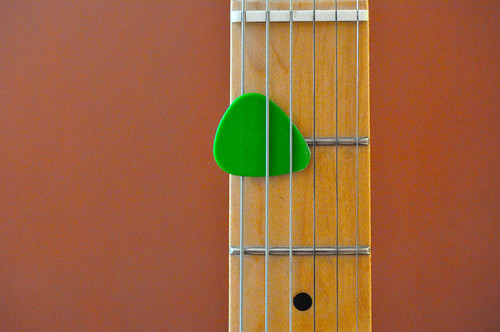
1st Fret Pick Holder
1/30th of a sec f/8 50mm ISO 6400

What is your brand? I first heard about the concept of branding when I was working a a computer tech for a Madison Ave. advertising agency over ten years ago. They used to bring me as “insurance” and to run the Powerpoint decks during their sales pitches. I didn’t know it at the time, but I was receiving some of the greatest marketing training while clicking the right arrow button on a PowerBook. The big buzz word that always came up was branding. I was also involved in their focus group meetings when they would help a company define their brand. They had a patented process for figuring out a brand for a company and then using that data, they would transform that branding into advertising. So what is branding for a photographer?

Branding is the culmination of everything that makes an entity distinguishable from other similar entities. For a creative professional, it’s your creative style, your looks, the music you listen to, your political beliefs, your spirituality, what you ate for lunch yesterday. In other words, it’s all of the stuff that makes you you.

The easiest brands to define are the ones that have extreme positions. Lady Gaga was just another singer/songwriter as Stefani Germanotta. Once she took an extreme left turn and discovered her fashion style and changed her name to a Queen song title reference, she went from a successful yet unknown songwriter to a household name. But what if your personality isn’t truly extreme in any of your beliefs or style? That’s OK. In fact, that’s exciting. You get to discover and expand your brand!

Wait… What?

Just like a fingerprint – the elements of your brand that make you you when combined like the ingredients in a family recipe are unique. That means you can exploit those points that excite you the most and clearly define them by pushing them harder. Soul searching is something we should all do on a regular basis because you need to define yourself before you can clearly sell yourself. Even though you are unique, you share parts of your beliefs and style with a lot of other people. That’s what makes people attractive. That’s how you strike a chord with your potential fans.
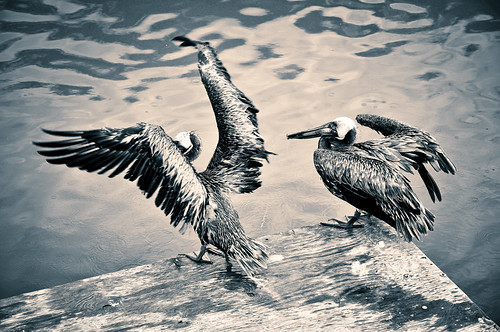
Shem Creek Pelicans
1/320th of a sec f/5.3 62mm ISO 200

Try to define your current fashion style and refine it. What does it currently say about you? What would you change about it to push your intent further? Can you push it to an extreme and still keep your identity? How about your photographic style – What type of photography are you most comfortable with? If you take nature photos, how can you do something extreme and unique with it? Can you get closer or expose in a non-traditional way that pushes you into a creative place that you may have only touched on in the past?

Most importantly, when you do decide to go big and make some huge leaps in defining your brand, make sure you’ve got the chops to back it up. Lady Gaga would have just been another Milli Vanilli if she didn’t have the talent to back up her uniqueness. It would be tragic to have a brilliant marketing plan with no worthy product to market. I don’t believe in style over substance, but I do believe strongly in a style that matches the substance you have to offer. I speak of these things not as a professional photographer, because that is a realm I’m just starting to explore, but as a musician who was signed to a recording contract and toured the world and more currently as a small business owner who’s made it past the dreaded five year mark and is still expanding. Throughout all of my journeys in life so far, the most successful people and businesses that I’ve come into contact with are the ones who are clearly branded. So I ask again, what’s your brand?
What Comes First?

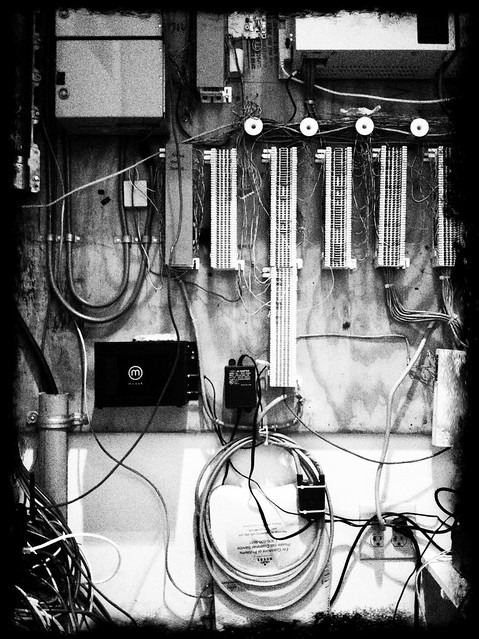
Soul Killer
iPhone 4 – Edited in the Camera+ App f/2.8 1/15th sec 3.9mm ISO 800

The first week of the year is complete and my wife and I have been actively looking for an assistant to help us with our respective businesses. We have a couple of prospects in mind and will be sitting down with them next week. Hopefully we’ll find the perfect person to grow with us so that I can officially start the creative side of my business to balance out days like today when I get stuck looking at data closets such as the one above for hours on end.

I do love my technical business, but it can be a real drain on your spirits. According to the test on this site, I’m 45% left brained and 55% right brained, which means I need to balance the two sides to stay sane. If I spend too much of my time doing tech work (which is my current situation), I eventually feel torn, frayed, and drained. Making part of my living doing creative work should satisfy my slightly right-brained dominant head. I do believe that a full time career in photography would actually satisfy both sides on its own due to the gadgety nature of the business, so that is always a path I will have open to me if I feel the need to traverse it.

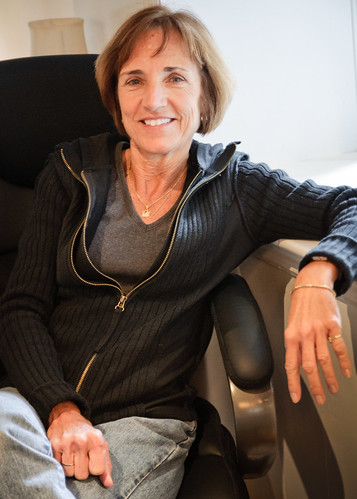
I-Need-A Assistant Like Anita
f/2.8 1/30th sec 50mm ISO 1600

I got one of those hokey bank loan checks in the mail last week for $6,000, which brings me to the point of this post. I was really tempted to take the loan. I mean, really tempted. I had a cart filled up at Adoroma with one camera and lens package that would max out that loan with one click. Then it got me thinking. I do like my current camera, and I’ve fired the shutter over 60,000 times which means it’s a little over halfway through its expected life. I will need to get a full frame camera next, and I’d like to have a fast zoom lens that will allow me to shoot editorial type shots using natural lighting. The shot above of the lovely Anita, who’s the amazing assistant at The Wiles Law Firm, was taken using the window light and ambient light of their office. That is me pushing my current camera’s capabilities. I’m shooting at f/2.8, which is considered a fast aperture, and my ISO is pushed to 1600 (which is the highest I let my camera shoot in most situations because it tends to get ridiculously noisy over that). At 1/30th of second, I’m not freezing motion, so if she moved, it would be blurry. With a newer full frame camera, I can easily triple the usable ISO, if not more. So that’s a pretty strong case for upgrading my actual camera and lenses soon if I plan to pursue shooting events. Not to mention that a full frame camera gives you a proper handle on your focal lengths which means I could have better control over lens distortion and bokeh.

The other major equipment expense I need is lighting. Right now, I use portable flashes. In fact, if I had taken the same type of shot above and brought out my umbrellas and flashes, I could have made an extremely clean and well lit photo. If I were to take the portrait outside during the daytime though, they would be less effective as light shaping tools because they are not powerful enough to really help me turn day into night and vice versa. I would have to be in the shade or wait until dusk for the right light to really make something that works well. If I were to invest that money into a professional strobe lighting system and modifiers, I could wait on the expensive camera because I could create the ideal lighting situation that my camera could handle. I really want to pursue creative lighting solutions because to me that is a huge part of photography and with the correct equipment, you can make the right light, not find or wait for it.

So, dear readers, what do you think is more important to start with – the pro grade camera and lenses or the pro lighting system? And to be clear, I did not cash that loan check. I don’t want to begin my photography career upside down in debt. I plan on saving for this stuff the old fashioned way, even if that means mowing some lawns!


Get A Little Closer

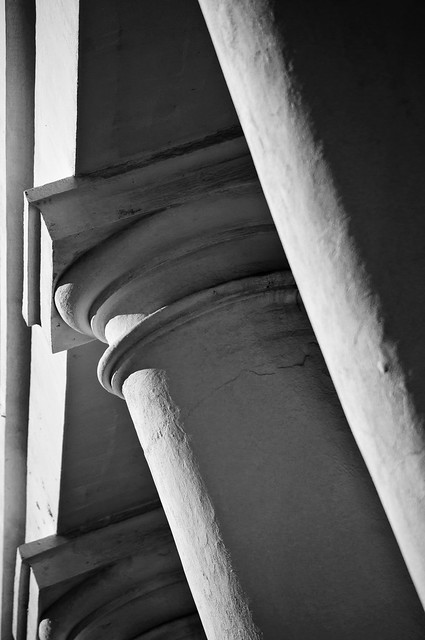
Buildings
1/2500 sec f/5.0 165mm ISO 200

I took this photo of the columns of a church on Hasell Street the other day in this fashion because the light was really hard. Instead of fighting the light, I decided to get in close to exploit the hard nature of it. By focusing closely in on the lines and contours of the columns, I am able to create a graphically rich and textured photo of one of the more defining elements of a grand old Charleston building.

Sometimes the details of the scene can tell more than a wide literal shot. What is it about the scene that attracts you to it? What naturally draws your eye in the real scene (not the one in the viewfinder)? Try isolating those compelling elements and making a photo about them.

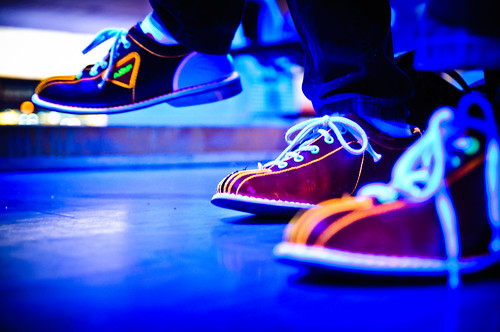
Bowling at AMF West Ashley
0.8 sec f/2.8 40mm ISO 1600

In the scene above, the lights had just dimmed and the black lights came on as “Rock N’ Roll Bowling” started at the AMF West Ashley bowling alley. They must have recently replaced all of their rental shoes, because I immediately noticed everyone’s glowing white laces and trim on their bowling shoes. I put the camera down at foot level and focused on the middle foot. Without showing a ball or pin, most anybody who’s ever been bowling before will recognize exactly what this shot is about.

While you should always move around and find different angles, don’t forget to get in close and fill the frame. A lot of my favorite photos are very simple compositions with only a few major elements. The best way to achieve that is to get in so close that there’s no room for anything else!


Finding Your Composition Part 2

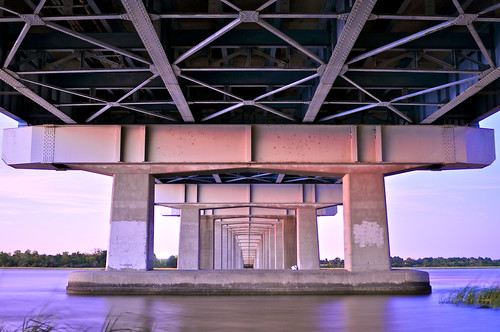
Day 25 - Under the Cosgrove
10 Seconds f/2.8 28mm ISO 200

I really enjoyed writing yesterday’s post. It’s truly a joy for me to talk about the decisions I make when making a photo and also why I choose my favorites from a shoot. I tend to flood my Flickr stream with a ton of different stuff, most of it out of context. Here on my blog I get to put things into a format that explains why I made the shots I did.

I was very pleased to see David duChemin’s blog post today talking about composition. He’s basically reiterating the importance of expression over conforming to the rules of composition. The point I think we both agree on wholeheartedly is that your vision needs to come from within you, not from a set of theories passed off as rules by the general population of some past era in design. Artists like Jean-Michel Basquiat made their statements through their individual and unique expression, not technical prowess.

As I continue to pursue the ideas I get in my head about what specific style I want to define myself with as a photographer, every once in a while I see something very extraordinary that brings out the child-like quality of why most of us ever pick up a camera. A scene screams to you – shoot me!! This was one of those scenes:

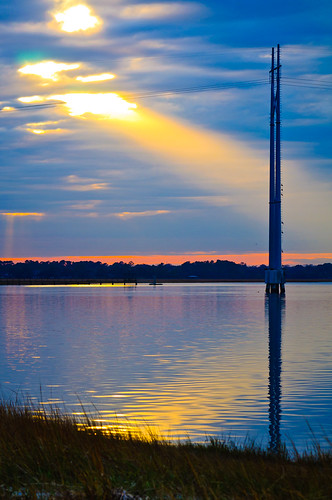
Sunbeam
1/125th of a second F/8 92mm ISO 200

I have a favorite spot I revisit underneath the Cosgrove Bridge in Charleston, SC that a lot of fishermen like to hang out at. Later in the day on New Years Eve I was traveling over this bridge and got giddy when I saw a beam of light peering out from a break in the clouds. It was mystical to say the least. I would have beaten myself up if I didn’t pull the car over and start shooting. After grabbing a few shots I liked, it was gone. I was left with this completely different photo:

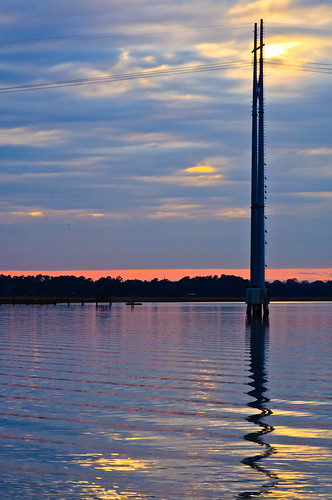
Sunset
1/100th of a second f/12 120mm ISO 200

Now that my main element (the light beam) was no longer in the picture, I was able to look around and explore the effects of the clouds and the light over a scene that’s quite familiar to me. Slightly to the right of the two photos above was this scene:

Sunset
1/125th of a second f/8 55mm ISO 200

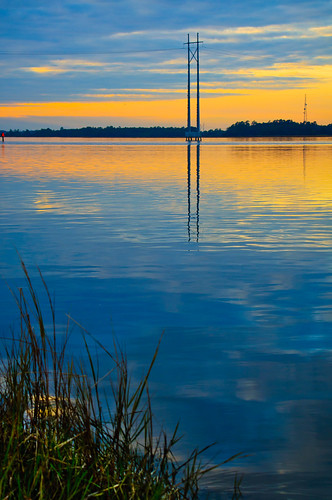
Notice how the color at the horizon is completely different at this viewpoint and time? I also took advantage of how the clouds were breaking and making triangles at the edge of the scene. While the first two have a horizon that’s nearly in the middle of the shot (some would say that that is a no-no, I say phooey), this one demands a different approach. The mirrored reflection in the water combined with its original elements compliment in a visually balanced way with the grass in the foreground. This was all very intentionally placed in the viewfinder as I composed the image. The secret to successfully composing scenic shots like these for me is to treat each element as a graphical object and place them in a way that they fit for my vision of the scene. My thought process usually begins with a voice in my head telling me, “this looks ‘right'”. After I get a shot like that, I’ll start to expand on it and step out of my head, because that bastard doesn’t know everything and needs to be stood up to every once in a while!

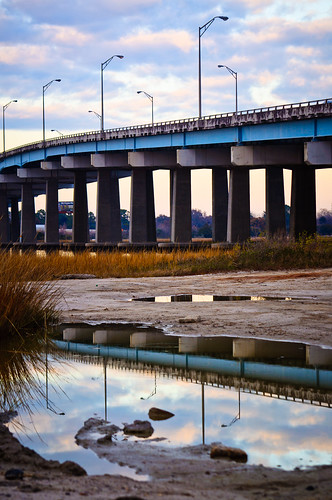
There was something very graphical and cool going on behind me with the clouds, the bridge, and a small pool of water in the foreground. I kept trying to find the best composition and settled on these few elements I just had to include. I started here:

Bridge Reflection
1/125th of a second f/8 85mm ISO 200

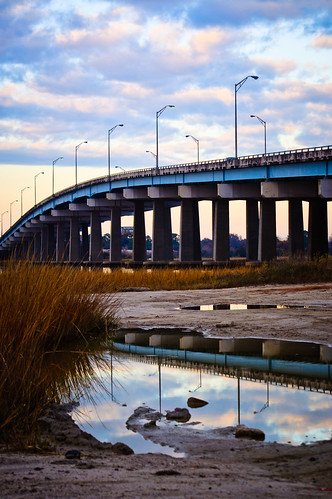
I wanted to show a bit more direction with the bridge and include more of the bush. I stayed in the same spot and moved my point of view and focal length slightly to get this:

Bridge Reflection
1/125th of a second f/8 68mm ISO 200

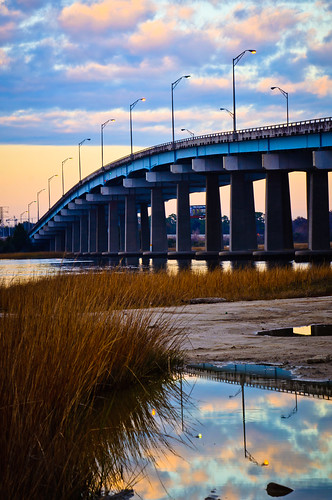
I was pretty happy with that last shot. I moved on and started shooting other stuff in the area for a little while. Then, as I was getting back in my car I looked once again at the same scene. Now the color and position of the clouds had gotten so much more vivid that I had to shoot one more shot of this scene. This is how I composed it this time:

Bridge Reflection
1/125th of a second f/13 92mm ISO 200

I like the last two for different reasons. This last one has a better definition in the clouds and the line of the bridge has a vanishing point that further conveys its direction through the image. I do like the inclusion of the dirt before the pool of water in the first two, but traded it off for that expanded bridge line in the third one. Photography can really be a game of give and take for more reasons than just light values! You see, there were fishermen there and their cars were parked right in my line of sight to the left of the frame. In order to eliminate them, I had to deal with what I had and make it work.

I hope to do a 3rd composition installment in the future involving portraiture, but I’ll need to shoot those shots with publishing the exploratory pics in mind! Thanks for reading. I hope you have a great start to your year. We had a bit of a scare in our house, but it all is seemingly working out now and we’re stronger for overcoming it. “Resistance” has its work cut out for it if it thinks it will hold my family back from its dreams!


Finding Your Composition

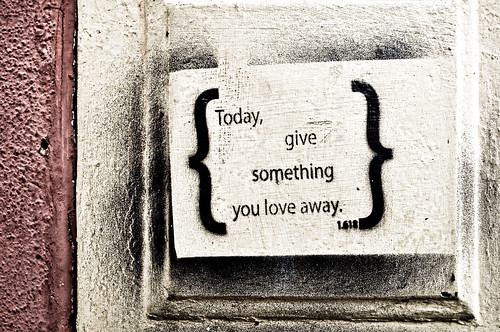
Day 126 - Give It Away
1/200th of a second, f/4.5 22mm ISO 200

When talking about any style of photography, a consistently important factor is composition. If the composition doesn’t connect with the viewer, the picture is overlooked and it fails. When you first become aware of that fact, the issue becomes “How do I change static elements to fit into a better composition?” The answer is usually a simple one – you don’t, you change yourself.

There are plenty of rules that you should know – the rule of thirds, the golden ratio (as featured in the photo above – 1.618), and compositional balance. There’s also the rule of odds, which tells us that three birds is better than two, and the rule of space which suggests that negative space should be used to suggest movement and/or tension. I try to break these rules on a daily basis, but I also try to use them as a reference point. I have not forgotten my own instincts on composition, and combined with the knowledge of the traditional concepts, I find that gives me the opportunity to step out of my own head to explore more possibilities. Lets look at four photos of the same exact scene composed in different ways.

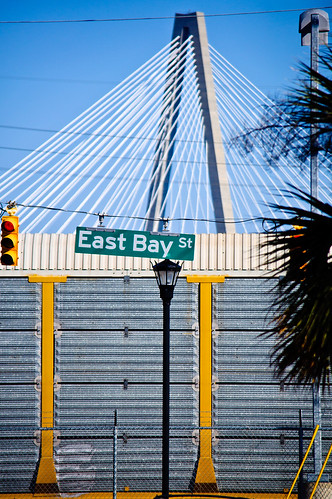
Yesterday I was parked about a block away from a client and decided to do an impromptu photowalk. As I parked, I saw this scene below in my mind just as it’s composed and liked the combination of the shapes of the foreground, middle, and background as a flattened 2D image. I shot the exact scene as I envisioned it.

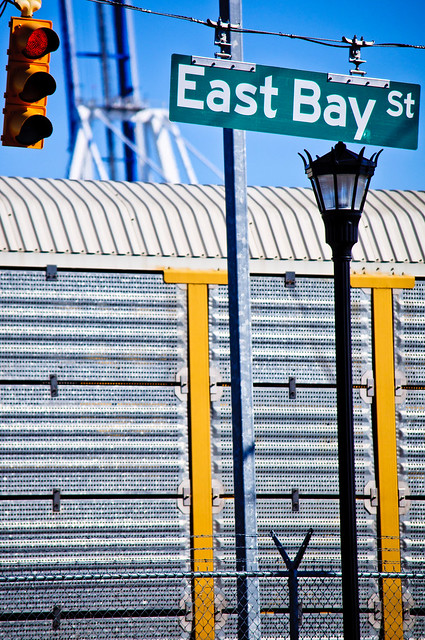
East Bay Street
1/2500th of a second f/5 180mm ISO 250

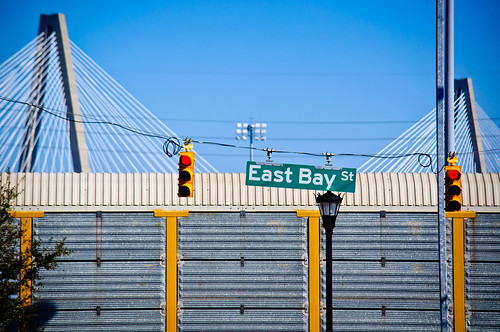
After I got what I wanted, I decided to change the orientation to a landscape shot and used pretty much the same point of view. This brought in some more elements and creates a more recognizable image.

East Bay Street
1/2500th of a second f/5 185mm ISO 200

I preferred the vertical composition and tried to re-arrange the elements. This time I moved to the left and zoomed out a bit. I was using my 55-300mm DX lens, which is an awesome and inexpensive piece of glass. I like the composition of the foreground elements (the lamp post, the light, the sign, the sidewalk, and the fence), but I don’t think the background is as powerful with the placement of the crane and the bridge.

East Bay Street
1/2500th of a second f/4.8 116mm ISO 200

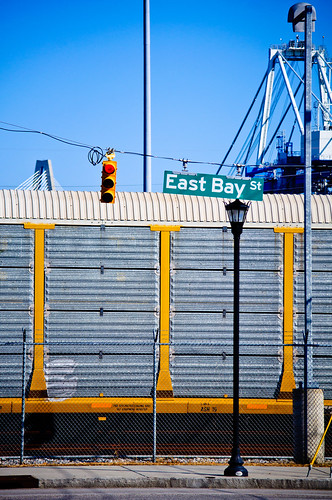
Finally, I took a break and shot some other things before I eventually came back to this scene. Sometimes it’s best to gather inspiration by shooting unrelated photos so that when you go back to the first scene, it’s like a whole new vision to behold! This time I got closer. I placed the foreground elements in an evenly spaced way at the top third of the photo and brought out the texture of the fence and train car for the bottom two thirds. The background crane gets blurred and adds a bit of dimension to the shot – this helps more clearly define and separate the foreground, middle and background elements. The gray texture of the train car replaces the sky as a source of a negative space-like element. By moving closer, I also managed to fill the fame. In my opinion, this is the most successful composition of this scene out of the four.

East Bay Street
1/2500th of a second f/5 200mm ISO 200

It’s all the same stuff, I just moved my camera around to include, remove, and alter the view of it. The truth is that there is no correct composition of this scene – It’s all up to you and your tastes. People who view them will have their own reasons for liking different versions, just like some people buy red cars over yellow ones. The power we have as photographers is to define and show what we like in hopes that others will connect with you on it as well. Art is all about relationships. The relationship of the elements on a fundamental and tangible level as well as the relationship of style and intent on a philosophical and spiritual one.

Which one do you like? Why?


Happy New Year 2011!

New Years Eve Morning Glory
50mm 1 second at f/1.8 ISO 200

This is going to be a spectacular year – I can already feel it. Unlike most years in recent history, there’s a collective sense of greatness for 2011. I hope all of the best for you and your loved ones. Happy new year!


Privacy Settings
We use cookies to enhance your experience while using our website. If you are using our Services via a browser you can restrict, block or remove cookies through your web browser settings. We also use content and scripts from third parties that may use tracking technologies. You can selectively provide your consent below to allow such third party embeds. For complete information about the cookies we use, data we collect and how we process them, please check our Privacy Policy
Youtube
Consent to display content from - Youtube
Vimeo
Consent to display content from - Vimeo
Google Maps
Consent to display content from - Google